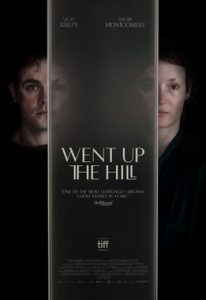
Parapsychology (the study of hypnosis, telepathy, and the paranormal) is a fascinating backdrop for horror as such a study generally lacks any empirical evidence or even scientific methods. That makes Samuel Van Grinsven’s new Australian film WENT UP THE HILL all the more provocative as it is a character study of a ghost that affects its two victims as much in its spectral form as it did in its human form amongst the living. It’s a modern ghost story that examines one human being destroying lives amongst the living and equally beyond the grave. WENT UP THE HILL also is one of the year’s better frighteners, a far more successful and upsetting genre entry than WEAPONS or BRING HER BACK could hope to be.
The story, written by Van Grinsven and co-screenwriter Jory Anast, concerns two victims who have been terribly damaged by the strong will and sins of Elizabeth, a character that we never fully see in the film, even in flashback. Her two victims are her long-abandoned twenty-ish son Jack (Dacre Montgomery) returning to a remote New Zealand community to attend her funeral, and Elizabeth’s forty-ish widow Jill (Vicky Krieps). The intimidating mountains and overcast skies of the landscape set the stage for Jack’s return, as this world feels unequivocally and naturally set against him. Elizabeth gave him up, you see, when he was a wee lad, and he’s not been back home again, nor sought out ever since. Jack’s crashing of the small funeral held in Elizabeth and Jill’s austere home rubs the guests the wrong way as no one cops to inviting him. Jack insists Jill did, but later on the widow surmises that her dead partner somehow contacted him as her presence is still felt in the house.
That could be because Elizabeth’s casket sits in the middle of the living room for the funeral and is not removed until a few days after. It also explains why both Jack and Jill start to feel Elizabeth getting under their skin, both literally and figuratively. Indeed, things go from eerie to worse when shockingly, the specter of Elizabeth starts to possess both, albeit at different times, and exploits their ‘vessels’ to commingle and communicate more thoroughly with the other. After such encounters, Jack and Jill awaken from the experience feeling as if it was all part of a dream, but there are physical effects on their person painting it as all too real. Eventually, to connect even more to the two, Elizabeth inhabits Jack in order to make love to Jill and it makes for a scene both weirdly poignant and unseemly. Much of the film is such a blend of pathos and shock.
But then the whole film finds a certain cool yet perturbed stance in its unique plotting as the story examines these two lost souls trying to understand Elizabeth’s past as a terribly flawed human being, as well as her present as an inappropriate ghost. The color palette of the film throughout is painted in grey and brown, lending a sense of atrophy and decay to every moment as if the specter is controlling that as well. The sprawling, elegant home feels cold and cruel more and more as the film goes on and less like a home. In fact, the place starts to feel like a tomb.
Krieps and Montgomery are superb, playing it very realistically, and imbuing their characters with subtle shifts to indicate when Elizabeth is possessing them. Krieps is particularly effective, eerily so, by merely lowering her gaze to achieve the judgmental eyes of Elizabeth when she inhabits her body. It’s an unsettling performance in a wholly unsettling film. And as the three characters blur lines more frequently, another strange thing occurs – Jack and Jill go up the hill to discover a love for each other beyond what Elizabeth is using them for. It’s the closest thing to living for these two who are going through their own throes of disintegration.
The film is a deft 100 minutes, yet it feels more prolonged and disturbing due to its dreamlike state and slow, hypnotic pacing. It’s as if we are being lulled into its ghostly netherworld along with the two protagonists. The cinematography by Tyson Perkins, score by Hanan Townshend, and editing by Dany Cooper, all contribute to the unease, as do some volatile scenes that take place on an icy winter river nearby. You may not jump out of your seat that often while watching this film, but you will remain on the edge of it due to the terrors being instigated by Elizabeth.
WENT UP THE HILL is well worth the trip to the cinema this weekend as the scale of the images, sound, and ideas presented here deserve such fully immersive trappings from a big screen. It’s all beautifully produced, moving, and may very well encourage you to question if paranormal activity is really all that farfetched. At the very least, you’ll appreciate how both the past and present can haunt susceptible lives.