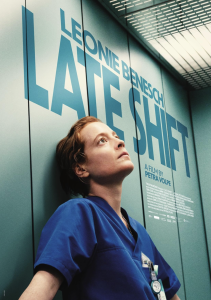
Screenplays have storytelling beats that almost every film follows slavishly. An inciting incident happens in the first 10 minutes to get the plot rolling. At the half-hour mark, the hero’s goal in the story becomes apparent to the audience. Hitting the hour mark, the story’s stakes are raised and/or shift some to keep us surprised. And 90 minutes in, things look bleak for our hero, but alas, the fates will shift in his or her favor by the end of the 2-hour running time. None of these tropes, however, seem all that apparent in the 2025 Swiss medical drama LATE SHIFT that’s now available on Amazon Prime and VOD elsewhere after a month playing in theaters in select USA cities. And because none of the story or its beats feel obvious, the film is better for it. And so are we watching. It’s a cool, calm, yet affecting drama, one of the year’s best so far.
Leoni Benesch plays Floria, a strong and committed nurse in an understaffed hospital in a city in Switzerland. As she arrives for the late shift, she’s given the basics about the patients she’ll be looking after on the floor, as well as information that they’re again short-staffed this evening. Most movies would make a lot of this with some tense music on the soundtrack, but writer/director Petra Volpe is never so obvious. Instead, it’s played matter-of-factly by the whole cast with Benesch barely reacting to it. For Floria, it’s just another day at the office.
Soon enough though, Volpe and Benesch will show us all that Floria is up against. Volpe has cinematographer Judith Kaufmann’s camera follow Floria around almost like it’s attached to her hip, and the nurse is nothing if not in constant but controlled motion. Gliding from room to room, patient to patient, this prescription to that one, Floria is the picture of confidence, experience, and level-headedness. After 20 minutes, you’ll stop waiting for a big ER/THE PITT style crisis to announce itself because it won’t. Instead, this is a quietly intense film that establishes its drama through the everyday in an evening in Floria’s life and her incredible, yet very human abilities to be caretaker, authority, and friend to the oodles of people she’ll touch via her demanding job. You start to realize that every interaction is a big deal to the many varied patients and Floria is the glue that is holding them together, as well as the very hospital providing all the care and services.
Another example where this film defies the typical medical drama tropes is in how few doctors are seen in the story. All the less assisting the often on-her-won Floria. Instead, it’s the custodial staff, a few members of the security staff, and a laissez-faire intern who surround Floria, often being as much a hinderance as help. The film is showing the truism that essentially, nurses run any hospital, especially since they are tasked with having to handle all kinds of patients, situations, crisis’, and medicines. It’s a credit to Benesch that she not only plays the almost unflappable Floria so smoothly, but also that she performs all of the detailed parts of a nurse’s vast amount of skills like she’s to the manor born. Critics and audiences tend to overpraise the Timothy Chalamet’s of the world for learning to imitate a celebrity or learn how to play ping pong, but Benesch here has learned easily a hundred nurse’s tasks, and she makes them all look second-nature throughout the film.
She just does all of them, without fanfare, without the spotlight. Indeed, the big, obvious beats never feel apparent in her character or the story, but that doesn’t mean the film lacks drama. Quite the opposite, the drama occurs in virtually every scene, quietly, but with edge as Floria is tasked with this need-state and that need-sate. One minute we’re watching Floria change a diaper of an incontinent older woman, the next we’re marveling at her managing the egos of selfish visitors and entitles private room patients. Floria is shown changing sheets, handling million-dollar equipment, and gathering the right medications from so many drawers and cabinets, it would make anyone’s head spin. But not hers. Floria assuredly stands up to arrogant doctors, calmly scolds patients who don’t follow protocol, and even finds time to tutor that blithe intern who thinks less people in the hospital should entitle her to longer breaks.
Floria also finds time to do God’s work, if you will, holding the hands of frightened patients, singing with a patient who is lonely and frightened, and listening to the fears of a mother battling cancer who wonders if the fight is worth it. Floria is a good listener, an even better moral force, and clearly, one superb nurse. Every experience is important to her, few are rarely important than any other, and the awfulness, as well as the joyful moments, are all part of the job.
That insight alone is worth an audience’s attention, but Volpe has made LATE SHIFT even more deserving with its medically accurate script, flawless production values, and inspired casting. And in Benesch, she has found a leading lady who excels at underplaying and bringing out the humanity and pluck in her characters. Benesch is one of the best and intrepid actresses working today, making such working stock into superheroes that Scarlett Johansson should envy. You may recall that Benesch made such a vivid impression as the lead in the educational drama THE TEACHERS LOUNGE a few years back as as one of Oscar’s Best Foreign Film nominees in 2024. She also played the hard-working Munich journalist covering the Olympic hostage crisis at the 1972 Olympics in the film SEPTEMBER 5 from that same year. Benesch has played all kinds of roles in her time on screen, but she’s turned out to be utterly exceptional at playing intrepid women in vital, important careers.
Ultimately, LATE SHIFT surprises so by being so unexpected from the typical film story. Still, it never fails to be involving, thoughtful, and moving. It also makes a very good argument for the world to pay more attention to the shortage of nurses as healthcare becomes more and more the key issue in any and all countries. Dare one say, the lack of them is becoming an epidemic. This film goes a long way in making the case, and it is a terrific movie to boot.