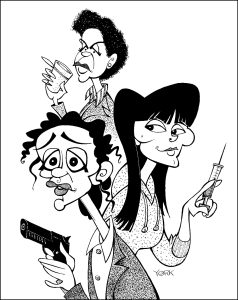
Original caricature by Jeff York of Emmy Rossum, Quincy Tyler Bernstine, and Lola Petticrew in FURIOUS (copyright 2026)
(NOTE: THIS REVIEW CONTAINS SPOILERS.)
There is a moment 13 minutes into the season one finale of the new Hulu crime thriller FURIOUS when serial killer Catherine asks FBI agent Alice if she’s ever killed someone. Alice answers that she hasn’t, and Catherine retorts with the confidence of someone very experienced at murdering child-raping men whom she has been targeting in the name of justice.
“It’s power. Watching someone die…when I’m killing someone, it’s like I’m eating him. Like swallowing him, like everything he’s ever done is disappearing inside me and I have all the fucking power in the world. And they don’t want us to have that. They want to take that from us. But I want you to feel it.”
Catherine wants fellow child rape victim Alice to feel the power. And the streaming series FURIOUS wants the viewer to feel it too, by sharing insights through the lens of its female characters, no matter how unsavory. Finally, the show cannot be experienced without a female POV, since women were instrumental in producing and directing it and in writing all but one of the show’s eight episodes. Creator and showrunner Elizabeth Merriwether deserves major hosannahs for giving her procedural such fresh perspectives, not to mention all of its other exemplary attributes.
Premiering on Monday, July 27th, the series earned rave reviews and, week by week, grew in narrative brilliance while becoming one of the most talked-about shows in the Twitter-verse. As a procedural, the series avoided most of the genre’s overused tropes and hoariest of clichés, instead aiming to constantly surprise, shock, and devastate. And it did so without ever feeling grotesque or exploitative, which is really saying something when it comes to a plot revolving around a serial killer.
How did it do so many different things so well? For starters, the serial killer Catherine, played with sly confidence by Lola Petticrew, was a very smart killer, one that required both the FBI and the NYPD to pursue. Catherine was shrewd, complex, often sympathetic, and her violence was not vicious to be vicious, but rather, it was warped by being trafficked as a sex slave years earlier when she was only 14. She systematically kidnapped the rich Manhattanites who were her perpetrators and extinguished their lives via lethal doses of fentanyl.
Additionally, the main character of FBI lead agent Alice, played brilliantly by Emmy Rossum, was a smart and earnest agent, but one whose personal life could best be described as a trainwreck. The incredibly flawed Alice, much more than most protagonists on television, liked to drink, screw co-workers, get slapped around as a fetish, and even go days without personal hygiene care due to various hang-ups, including her inability to reconcile her own past as a trafficked pre-teen. It was that commonality with her prey, Catherine, that gave their dynamic something akin to sisterhood and understanding, rare as well for a serial killer storyline.
The third main character in FURIOUS was Alice’s boss in the FBI’s sex crimes unit, Nora, and she was, in many ways, just as much of a trainwreck. Nora was a bitter veteran who loathed her male superiors and often drank on the job. She was a good agent despite her issues, and she recognized Alice’s talents in the field, but she was also wary of her charge’s self-destructive behavior. Quincy Tyler Bernstine played Nora with subtlety and nuance, rendering her a supporting player serving as comic relief, a Greek chorus, let alone a wise sage, all rolled into one. Nora became one of TV’s greatest breakout characters in recent years, and Bernstine was masterful with every second she was on screen.
Another refreshing aspect to the series was how every character, even the smaller supporting ones, was vivid. They were often tragically flawed yet portrayed by a truly flawless cast. (The series’ three female casting directors should win all kinds of awards for their efforts here.) The series locations had a grittiness and a lived-in quality to them too, essaying the kind of dangerous urban sprawl seldom seen since the heyday of filmmaker Sidney Lumet, who illuminated New York City onscreen with such classic films as SERPICO, DOG DAY AFTERNOON, PRINCE OF THE CITY, and Q & A.
The show succeeded, in part as well, because it couldn’t have been timelier, what with its child sex-trafficking angle, conjuring up all the elusive truths of the Epstein files. The series was crisp and tight, with no filler, and moved electrically across eight episodes with clarity and economy. Sublimely acted, Rossum, Petticrew, Bernstine, and Scoot McNairy as Alice’s gruff but kind NYPD colleague should all be in awards contention, with nominations to be expected in a dozen other categories as well. But beyond such obvious A+ attributes, the show’s many intellectual layers elevated it beyond most procedurals, let alone typical television dramas. Indeed, the show had themes beyond its “manhunt” angle, giving the series added gravitas and an unmistakable uniqueness, including these:
MIRRORING
Catherine and Alice had similar backgrounds, and their character dynamics were built on those commonalities rather than on traditional law-enforcer-vs.-criminal tropes. Right up to the end, Alice treated Catherine with more sympathy and empathy than contempt. Additionally, the show compared and contrasted similar fraught backgrounds among many characters, most notably Nora’s past transgressions stacked against Alice’s.
DELAYED JUSTICE VS. SWIFT REVENGE
The show questioned the legal system’s value, given its entanglement in politics and red tape, compared with the immediate, violent retribution Catherine exacts. Even when arrests were made, and some form of justice prevailed, many other culprits escaped through the cracks.
COMPARISONS TO THE LEGEND OF MEDUSA
The story of Medusa figures prominently in the series, including how Poseidon raped Medusa in Athena’s temple and how Medusa was then blamed for the crime. The gods punished her instead of Poseidon, transforming the beautiful maiden into a grisly hag with snakes for hair. The comparison to a raped girl being vilified was evident in numerous moments throughout the show’s storyline, as so often victim-blaming rises to the forefront in sexual crimes.
SOCIETAL DIVIDES
The world of those enforcing the law in the show was messy, often ugly and cluttered, despite their noble efforts. On the other hand, the sex traffickers’ apartments and mansions looked like pages out of Architectural Digest. Beauty disguised ugliness, and vice versa.
THE IDEA THAT ENABLING IS BAKED INTO THE CAKE
Finding a happy ending, or even justice, was an almost unreachable goal in a fraught world where almost everyone enables bad behavior to save their own skin. Cops were on the take to get ahead, women victimized other women to escape their own abuse, and good people allowed others to abuse them because it was often the most familiar route, providing a familiar, if not insidious, comfort zone.
And if FURIOUS zigged brilliantly when almost any other show at any other narrative point would have zagged, this series nailed the landing with its provocative finale. It turned tropes on their ears and set up a second season just aching to be realized. Catherine, despite her single-minded revenge on the men who victimized her and her best friend Isabel, remembered her BFF’s demise incorrectly. Catherine’s fury and violence were not only righteous but also an unconscious manifestation of her own guilt over helping kill Isabel to put her out of her misery.
Additionally, despite drinking on the job and being mouthy toward superiors, Nora kept her job. She also kept Alice in her department and under her tutelage. She even inspired the young agent to watch the video recording of her sexual abuse obtained from the crime scene, which made for an emotionally devastating final scene, one that should net Emmy Rossum a long-overdue (ahem) Emmy. (How was she not ever nominated for her sterling work on Showtime’s SHAMELESS series?)
Those final moments even served as a chilling prologue to the second season. When Catherine told Alice that killing gave her power, it left Alice with a lot to think about. Then, when Alice visited Catherine in prison after arresting her, the serial killer asked whether she liked how it felt to kill Jay Easton, the patriarch of the sex trafficking and abuse cabal. Those words echo in Alice’s head as she discovers her video has been downloaded over 50,000 times. Upon learning that, Alice flashes a subtle, knowing grin, suggesting she now has a veritable hit list at her fingertips and may continue the vigilantism Catherine started.
The gap between seasons of streaming series has become almost notorious, but here’s hoping FURIOUS returns as soon as possible. Vengeance is a dish best served cold, and this one needs serving immediately.