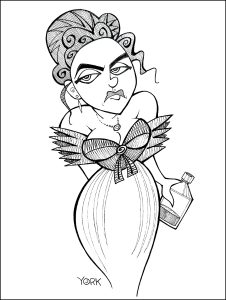
Original caricature by Jeff York of Florence Pugh in EAST OF EDEN (copyright 2026)
Today, more often than not, it seems we live in a world of antiheroes. Or at least, the difference between hero and antihero seems blurrier with each passing year.
In politics, the American President is a name-calling bully. Israel’s leader is hell-bent on annihilating his enemy. The movers and shakers of technology seem to be on a course to hinder human survival rather than assist it. Referees let Caitlin Clark’s opponents elbow her in the face while nary calling fouls. And even TV entertainment revels in the new villainy, as heroes like Matt Dillon, Captain Kirk, and Lt. Columbo have been gone long enough to make way for villainous leads like Tony Soprano, Don Draper, and Homelander.
This brings us to the new Netflix adaptation of John Steinbeck’s classic 1952 novel East of Eden. Filmmaker Zoe Kazan has created a seven-part miniseries that does a brilliant job of capturing the tenor, setting, and language of Steinbeck’s tale. The performances, production values, and writing make the show one of the year’s strongest and a formidable contender as we enter awards season.
However, one conspicuous change from the source material isn’t entirely successful and actually keeps the series from being truly great. Kazan has modernized much of the interpretation of Cathy Ames, the novel’s main female character and unquestionable villain. Kazan’s efforts to explain Cathy’s hatred and sinful acts via her fraught childhood may feel like modern storytelling, even feminism, but they belittle Steinbeck’s words and soften what should be an unquestionably frightening presence whenever she is on screen.
The story of EAST OF EDEN centers on two brothers and the strange woman who enters their lives and rips them apart. Adam and Charles Trask are brothers who grow up in post-Civil War America, raised by a strict father who lost a leg in that war and is revered as a Union Army hero. The boys learn to be stubborn, prideful, and macho, like their dad, and to live stoically as American men. It’s a recipe for disaster in a nation finding its footing as it changes rapidly, as a melting pot welcoming all stripes of people, as women expand their roles at various levels of society, and as nationwide communications bring everyone closer to neighbors near and far.
The brothers have a love-hate relationship, each wanting to be seen as an Alpha male. Kazan probes the competitive psychology of these two men, who have been competing since early childhood, especially for their father’s stingy approval. (He generally favors Adam, though Charles is the stronger of the two and more closely resembles the patriarch.) Christopher Abbott as Adam and Mike Faist as Charles are superb in the roles, though Charles should be a little more physically intimidating than the lithe Faist. Tracy Letts plays the stoic father, Cyrus, perfectly, and at times, Papa Trask is such a jerk that you’ll want to hiss and boo him.
In the second episode, things really heat up when Cathy takes center stage, crawling toward the house the brothers have inherited from their now-deceased father. She has been beaten within an inch of her life by her pimp, and the sympathetic Adam insists on taking her in and nursing her back to health. Charles opposes the idea and thinks he’s seen Cathy before, with both Steinbeck and Kazan implying that the more wayward brother may have encountered her in a brothel, as he fancies frequenting prostitutes.
When Kazan’s adaptation focuses on Cathy’s backstory, the miniseries runs into the aforementioned problems. In Steinbeck’s original story, Cathy is described as evil and born that way. No circumstances drove her behavior; instead, she was a bad egg from the get-go. That’s why she used a naïve high school teacher to curry favor by promising underage sex. (He committed suicide when she then rejected him and threatened to go public with his perverse letters to her.) Cathy also locked her parents in their country cottage and burned the whole place down so she could escape her provincial life and become a prostitute at a brothel before she was even out of her teens. The miniseries plays those plot points quite faithfully from the book, and Cathy comes off as manipulative and selfish, a very troubled girl.
She treats her marriage to Adam flippantly, bedding Charles on the side and showing little interest in mothering the twin boys she gives birth to less than a year into the marriage. Steinbeck raises the question of paternity early in the narrative, and at one point, Cathy even boasts that Charles fathered them. Cathy leaves her family to return to the profession of prostitute, and how she exits is one of the most shocking events in the story, faithfully rendered by the series.
But then, as her screen time increases exponentially, the series presents Cathy as a woman ahead of her time, seeking the freedoms men enjoyed and refusing to be a victim of the patriarchy, and eschewing weak, insecure men like her smitten teacher, strict father, husband, and insecure johns. Such shadings make her much more nuanced, sympathetic, and, yes, multi-dimensional, something she wasn’t in the book. Perhaps Steinbeck’s times were still far too discriminatory toward the opposite sex, but updating the material rings false to the author’s intentions and will frustrate purists.
As played by Florence Pugh, Cathy is even more complex, and at times, quite likable. She’s articulate and shrewd, with a head for business and a tendency to protect the girls in the brothel. Pugh’s performance succeeds brilliantly, even when Kazan’s reinterpretation of Cathy doesn’t. The character becomes the central figure in this adaptation, which throws off the book’s intent to examine men and their responsibilities as men’s roles start to broaden in America.
Still, despite Kazan’s modernizing and Pugh’s impressive star turn, most of Steinbeck’s vicious Cathy still comes through, including her cunning and her cold con of so many victims. Later episodes rely heavily on her taking over the brothel run by the kind, gullible Faye, creating clear parallels to Adam’s later struggles with both parenting and running his businesses successfully. Fortunately, two of Steinbeck’s best characters help Adam through the ups and downs: Chinese housekeeper Lee (Hoon Lee) and Adam’s close friend and neighbor Samuel Hamilton (Ciarán Hinds). Kazan does wonders with those two characters, translating many of their scenes from the book almost verbatim. Additionally, the two actors are superb in their parts, as is Martha Plimpton, who gives perhaps her best screen performance ever as Madam Faye.
Kazan also returns to the Cain-and-Abel allegories Steinbeck focused on, which recur as Adam’s sons grow into adulthood. The actors playing the twins, Caleb (Joseph Zada) and Aaron (Joe Anders), are fine, if not exceptional, but most of their story in the final third faithfully revolves around their father and the discovery that their mother runs a brothel. Caleb is bullheaded like his mother, while Aaron is more sensitive, like his father. Incidentally, the last third of the book is the part Kazan’s grandfather, Elia Kazan, focused on when directing his 1955 Hollywood adaptation, a big success at the time that benefitted from James Dean’s star power as the wayward Caleb.
Perhaps the best part of this adaptation of EAST OF EDEN is its enduring relevance today, especially its questions about good and evil, power and privilege, and the shifting roles of men and women. Even with too much sympathy for Cathy, it’s a marvelous production from top to bottom. It’s never been told better, even though the 1981 miniseries featured a performance by the great Jane Seymour as Cathy that was more faithful to the source material and a far more chilling portrayal of the antagonist.
Hopefully, this adaptation will encourage viewers to read Steinbeck’s original novel or other great works of his, for that matter, and provide a template for more filmmakers in Hollywood on how to more faithfully adapt great literature for the big or small screen. Despite the variations, this take is much closer than most such adaptations end up being. It doesn’t do justice to all 600 pages of Steinbeck’s story, but I’m not sure even a 10-hour miniseries could.
EAST OF EDEN also proves that television is still in the midst of a new golden age of superior storytelling…
…even if some series spend too much time trying to justify villains.