Christopher Nolan’s films have long distinguished themselves through technical brilliance, grand ambition, and a fearless sense of scale.
His command of image, sound, size, and setting remains formidable. Few contemporary filmmakers can match the precision with which he shoots, edits, scores, and composes visuals in his films.
And yet his scripts can be brazenly revisionist. In BATMAN BEGINS, he departed from the sacrosanct work of Bill Finger and Bob Kane to create a largely unrecognizable Ra’s al Ghul. In DUNKIRK, he fractured the timeline of the soldiers’ rescue from the beaches when the inherent drama of real history was already enough. And in the newly released THE ODYSSEY, he dares to give 3,000-year-old Greeks the cadence of contemporary Americans.
Nolan is extraordinary, no doubt, both in his artistry and in his appetite for provocation. He needs the former to remain one of cinema’s preeminent filmmakers. But does he need the latter quite so much? I think not.
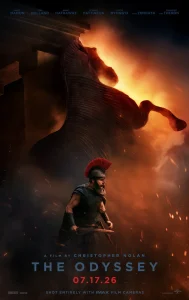
Both impulses are on display in his adaptation of THE ODYSSEY, an epic film with a capital E. The movie is breathtaking in its locations, its cast of hundreds, its practical visual effects, and the sweeping scope of a story that spans thousands of miles and twenty years. Adapting a 3,000-year-old poem of myths and monsters, gods and super-soldiers, honor and homecoming, is an enormous undertaking. Nolan makes a feast of much of it. He shows that war is hell, that fidelity to a spouse or a cause is a prickly challenge, and that the line between victory and loss is often razor-thin. He honors Homer’s essence, his outline, and many of the lessons embedded in the classic text.
But Nolan also alters the material, sometimes beyond what seems necessary. Wasn’t casting actors with Gen Z appeal—Robert Pattinson, Zendaya, and Tom Holland among them—enough to draw younger audiences into the cineplex? Did the dialogue also need to sound so emphatically contemporary, especially when Holland’s teenage Telemachus calls his mother, Penelope (Anne Hathaway), “Mom”? Does the frustration of King Odysseus (Matt Damon) with battles gone wrong really require the modern expletive “fucking,” as in “Fucking hell”? To me, these choices go a step too far, nearly gilding the lily. After all, Nolan turned an 80-year-old historical account of the atomic bomb’s creation into a riveting thriller for all ages with the outstanding OPPENHEIMER a couple of years ago. His achievement was also a massive box-office hit and an Academy Award-winning Best Picture, so clearly he knows how to move critics, audiences, and pocketbooks. But at times in THE ODYSSEY, one can feel Nolan almost overcompensating for trying to wrestle the ancient text into modern times.
Rewriting so much of the narrative to streamline matters for modern audiences, or writing dialogue aimed at the attention-fractured crowd, wasn’t necessary, especially when the story of a King out to conquer, who is thrown off course by wind and sea, is enthralling, no matter the time period. Odysseus may conquer lands and lay enemies to waste, but he loses his men and his focus, leaving him an older, embittered man, questioning his life choices. That comes through in Nolan’s take, even with the aforementioned flaws. And it still plays all these centuries later.
Nolan also gets top-notch performances from Holland, Hathaway, and Pattinson, not to mention Samantha Morton as the witch Circe in perhaps the film’s best set piece, where she transforms Odysseus’ starving soldiers into something beastly. Damon gives the film his all, even if he doesn’t have quite the stature or command as the character needs. And you have to see the scene with the 30-foot Cyclops to believe just how weird and wonderful an escape from a one-eyed giant can play in 2026. It’s both comedy and tragedy, and I mean that as the highest compliment. Additionally, Nolan’s take on what it really took to use the Trojan Horse guise to gain entry into the gates of the opponent’s home is something you’ve never seen before, and it is shattering.
Still, Nolan makes plenty of mistakes along the way that mar matters and keep the film from sustaining greatness. Charlize Theron and Zendaya are criminally underutilized; a blunt and gauche Jon Bernthal sounds more like he stepped out of Marvel’s THE PUNISHER than Homer’s brilliant poetry; and it’s almost shocking that Nolan misses the chance to show the sirens who sent many a sailor to their graves or to certain insanity with their piercing song. Wouldn’t those sea nymphs have been a perfect place to cast young actresses with Gen Z appeal, such as Sydney Sweeney, Jenna Ortega, and Rachel Zegler?
At almost three hours long, the film is never boring, but it has some other significant shortcomings. Nolan rewrites a lot of Homer, mixes up The Iliad and The Odyssey, and shifts some specific narrative cues around that will confound purists. Additionally, the score by the frequent Nolan collaborator Ludwig Goransson feels less cinematic than what you’d expect, settling into a space that’s more sound design than orchestral. Some of the costuming feels very modern, even too glamorous. And deciding to depict the fall of Troy well after it occurs in the narrative feels more like an editorial choice to underscore how often war takes no prisoners, a point we’ve already gotten by the picture’s climax, where it appears.
Ultimately, despite its flaws, this is a film that shrewdly makes the case for why cinemas need to exist and how streaming films on computers and TV screens just doesn’t cut it. The film does a lot of things incredibly well, even if it creates issues that may take you out of the picture. Nolan is truly formidable, and his filmmaking acuity is evident throughout here. Now, if he’d just get out of his way more often than not.