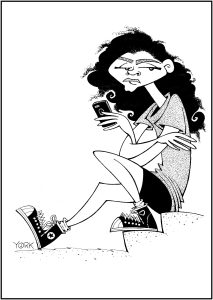
Original caricature by Jeff York of Zendaya in the first season of EUPHORIA (copyright 2019)
WARNING: SIGNIFICANT SPOILERS AHEAD.
Thank God for Colman Domingo.
He was so extraordinary in the series finale of EUPHORIA that he made the episode a lot more satisfying as the show’s end than it probably deserved. Ali, the featured character he played in the series, is not a regular, mind you, but he was the emotional core of the final episode as he was the only character properly mourning Rue’s death. It was Ali, her sponsor, who found her dead from poisoned drugs. He was also the one tasked with calling Rue’s mother to tell her the terrible news. Ali even avenged Rue’s death by killing Alamo, the drug dealer who laced Rue’s Percocet painkillers with fentanyl to ensure her demise.
So, bravo, Ali. And bravo, Mr. Domingo. Still, Rue deserved better. And so did we.
As any EUPHORIA fan knows, the third season was fraught with commotion before it even aired its first episode on HBO. There were four years between the second and third season, and that time lapse forced show creator/showrunner Sam Levinson to write the wayward high schoolers without properly ending their time in school. Instead, the time jump forced him to write the third season as one in which the characters were five years older, and graduation was long behind them. That giant leap ended up hurting every character’s storyline, leaving their youth unresolved.
And where they ended up five years later was riddled with character inconsistencies and nonsensical plotting. Rue (Zendaya) was still mired in the drug trade, now forced to be a mule carrying drugs back and forth across the Mexican border for drug kingpin Laurie (Martha Kelly). Nate (Jacob Elordi) married Cassie (Sydney Sweeney), a match anyone would’ve questioned, not to mention the incredulity that such a couple could have lasted five years. Meanwhile, the once world-class prick Nate was now being bullied by the gold-digging Cassie, who insisted on $40,000 worth of flowers for their wedding. And even when she realized he was in hoc to Armenian gangsters threatening bodily harm to him, she turned a deaf ear to most all of it. And we like this character?
The forever-scheming Maddie (Alexa Demie) was stuck in a crappy job in the Hollywood studio system, and so was the talented writer Lexi (Maude Apatow). Meanwhile, Jules (Hunter Schafer) was now little more than a kept woman, a sex worker to a rich, married client, hiding out in his luxurious penthouse, where she fiddled about painting her strange portraits if she wasn’t letting him degrade her sexually. These people didn’t seem to move forward in any meaningful way over those five years. Additionally, they were all still in contact with each other, which is hardly consistent with how relationships typically unfold after graduation.
If the head-scratching at Levinson’s plotting and character stagnation wasn’t frustrating enough to his viewership, the cast’s fame likely burdened the production and its chances for success even more, as Zendaya, Sweeney, and Elordi were now busy, successful movie stars whose loaded schedules clearly dictated limited time available for their return to television. The rumor was that some cast members didn’t even want to appear in scenes with certain fellow actors with whom they had fallen out. And indeed, it appeared that many were filmed in isolation.
Is this any way to bring back one of HBO’s biggest successes? The answer was self-evident from the first episode of the third season, as not only were all the aforementioned issues apparent in plotting, characters, and cast, but Levinson was no longer working with composer Labrinth, and the entire vibe of the series felt less like a dreamy remembrance narrated by Rue and more like an attempt to recreate the feeling of a Quentin Tarantino crime drama. Easy to assume, considering that most of the screen time, other than that of Rue, was given to the new villainous drug dealer, Alamo (Adewale Akinnuoye-Agbaje). He was a great villain, played well by the British actor, but the show seemed too weighted towards all things Alamo. And ignoring the main cast felt cruel. At the very least, hardly euphoric.
All of these issues led a boatload of critics and fans who once revered the show to skewer Levinson’s efforts this season, many accusing him of losing the plot, betraying the characters, coddling spoiled actors, and even trafficking in misogyny, particularly for the way he treated Cassie as such a woefully trampy OnlyFans sex worker. Placing the accomplished Sweeney in garb like a masturbating baby was a bridge too far for most. Granted, the series remained a “watercooler show” because of such brazen moments, but less so for more positive attributes. It was an easy show to discuss and even wail on when so much of it appeared to be flying off the rails.
Levinson’s writing seemed to beg the question whether he was even showing open contempt for his characters. After all, why were they all still so immature, so lost, so stuck in passive behavior? Which led many to wonder the following…
Was all of this intended as a way to indict the audience?
To shame fans for projecting so much hope and love for these self-absorbed, bratty teens from the first two seasons? Was Levinson pulling a “Larry David” as the famed writer and co-creator of SEINFELD did with that show’s two-part finale back in 1998? You’ll remember that the story put Jerry, George, Elaine, and Kramer on trial for failing to be good Samaritans when they failed to aid a citizen being robbed. The four went to trial, where many of the eight seasons’ guest stars returned to the stand to indict these cretins as amoral, self-absorbed stooges, incapable of human empathy. David was wagging his finger at us in the audience, too, for loving these shameful people. Despite their atrocious behavior again and again, audiences didn’t just watch SEINFELD avidly; they fell in love with these very flawed miscreants.
Indeed, the characters on EUPHORIA were similar in that they never strayed too far from their flawed essences, which were clearly visible throughout all three seasons. Rue was always in trouble with drugs or drug dealers. Jules’ need to establish her identity as a transwoman led her down a path of self-centered behavior, even dangerous actions via her sex work choices. Cassie always used sex to get love. Maddie used her viciousness to seek power. Nate’s sense of entitlement led him to bully those who had less than he did. And Lexi, the outsider, the girl not as cool as her friends, always seemed to zig while the others zagged, even exploiting their insider status in her savage play.
If this indeed was Levinson’s endgame, slamming his audience for misinterpreting his intentions for years, perhaps he was also ragging on his cast for getting too big for their britches. He certainly cut back Schafer’s screen time this last season to make her part feel like little more than an afterthought. Perhaps the show became both a blessing and a curse for Levinson. What else could explain his wild inconsistencies and jaw-dropping ridicule of some of the characters this season, particularly Nate? If not, then did Levinson get too close to it all and fail to see the forest for the trees?
My guess is that Levinson made most of his decisions with a cold, hard eye, much as he did in previous seasons. And while there were flagrant inconsistencies and too much emphasis on the character of Alamo, a lot of Levinson’s choices could be defended even if they seemed misguided. There’s no defending his almost complete dismissal of Jules as a vital part of the storyline, considering how she held so much of the light in the first two seasons. And showcasing all the tawdriness of the strip club and the OnlyFans biz felt too much like a hammer. But Nate’s cowardice and complete fall from his lofty position do fit with his regret over some of his bullying in the first two seasons. He didn’t release any of what he had on Jules’ sex work publicly, and he did help implicate his dad for his crimes. He was softening.
Additionally, not all talented people make it in Hollywood, and the struggle to get out of being veritable ‘gophers’ to agents or production companies plagues even some of those who are as headstrong as Maddie was or as seemingly talented as Lexi was. There was too much time spent on Cassie, but then she was always a walking cringe of a character. And if Levinson was guilty of any abuse there, it may have been in underlining his point about how she uses sex too vividly. We got it, over and over and over again.
I think the biggest problem in season three was two-fold. Clearly, it was a problem getting all the previous players together, and whether that was due to Levinson’s ego or the gap in seasons, most of it hurt the show. Levinson should have patched things up with Labrinth, as the score by replacement Hans Zimmer was okay, but not as crucial to the tone and vibe as his predecessor’s work. But the big hole was in how Rue was treated. Zendaya won an Emmy for each of the first two seasons for her extraordinary portrayal of pain, substance abuse, self-loathing, and sporadic bursts of hope and joy. In season three, however, Rue’s character felt almost redundant at times. As she had been there, done that, repeating behaviors she had failed at before, and her inability to learn from previous mistakes struck me and many others as nothing if not frustrating, or even demoralizing. We’d invested so much in the character and in Zendaya’s sublime performance that we expected more. We wanted to have a happy ending, and that was probably a pipe dream to be so gullible.
And while Zendaya was exceptional as Rue as she lay there on Ali’s couch dying from the fentanyl and hallucinating, it all went too quickly. As her life flashed before her eyes, she fantasized about reconciling with Fin, her mother, and her father, whose hoodie she always wore, and even fondly remembering her first experience with Jules. But it all happened so fast, too fast, and barely 45 minutes into the 90-minute episode.
Additionally, while her loss devastated those watching from the audience, Levinson failed to make Rue’s death have the impact it should have had on her friends. Perhaps they’d already given up on her, but it seemed to me that no one mourned her with particular zeal. Only Ali was discombobulated by it, but maybe he’s the only real friend she ever had. At least, while she grappled with addiction.
Rue deserved a better life, better friends, and a better path. She made many mistakes, tragic ones, but at least she was trying to get out of the mire. Her failure proved what I think Levinson was trying to say ultimately in his series – that we create our own prisons, be they damaging forms of addiction, self-hatred, or self-sabotage.
EUPHORIA was always ironically titled, as none of the characters were ever really happy or in a state of bliss. It’s a devastating realization. We wanted the best for these characters, despite their flaws, but Levinson kept questioning if they had the faculties to fulfill our best wishes for them. For me, the most shattering moment of the finale was realizing that Rue died alone, in the dark of evening, in pain, and on a couch in someone else’s home. It was a death that could not have been any lonelier for her. We were the only witnesses. Such a tragedy.
Rue deserved better. And even though it was stunning television in many ways, I wish the show had offered her a more positive escape. Granted, heaven is as positive a path as one can hope for, but her days on planet Earth were always trying and mostly tragic.
And that made watching the show often feel the same for us. Maybe that was Levinson’s point all along. If so, he certainly did succeed, even if the third season felt like a mixed bag.