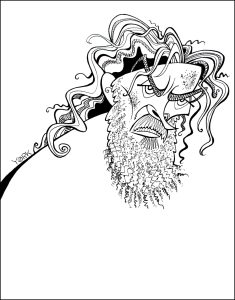
Original caricature by Jeff York of Hugh Jackman in THE DEATH OF ROBIN HOOD (copyright 2026)
The essence of writer/director Michael Sarnoski’s new film, THE DEATH OF ROBIN HOOD, is obvious from its very first scene. A brutal winter is bearing down on the mountains of Ireland, and a fraught, young woman hastily stuffs a few berries down her gullet for sustenance. She sees the glow of a fire higher up across some jagged rocks and makes her way to the camp. There, she finds a crusty geezer with long hair and beard, hunkered over his fire and cooking a skinned rabbit over an open flame. Reluctantly, he shares his food with her, and they exchange a few words. She mentions the name Robin Hood, and he tells her he’s not him. Not long after, the woman attempts to get the upper hand on him, suspecting he’s the famed killer and thief, but before she can strike, he surprises her by sticking his knife in her head. As she dies, he bluntly tells her that if she were to have succeeded, she’d have bathed to eliminate her essence.
This is that kind of story. Stark in its depiction of the elements. Cold in its portrayal of human interaction. The film is unapologetically brutal in its violence, action, and words. It’s also one terrific film. Well-acted, beautifully shot on the exteriors of Northern Ireland, and resolute in adapting the 17th-century ballad Robin Hood’s Death, this is often utterly stunning. And despite its brutality, the film is a heartfelt story of redemption. Throughout, the films asks, and we wonder, if even a wicked scoundrel like Robin can change his spots.
Hugh Jackman plays Robin, and it’s one of the year’s very best performances. Nowhere to be found is the twinkly charm and warm eyes of the famed actor that can light up a room. Here, he’s as beastly as he ever was in any of the X-MEN films or, in particular, LOGAN, and yet despite playing it mean and cold, he uses his body language and halting voice to suggest that ol’ Robin isn’t as sure of himself as he used to be. He’s nuanced and subtle, and he even adds some crag to his voice to make the most of the aging character.
After uniting with his old pal Little John (Bill Skarsgard, making for a superb ruffian), a shared skirmish with a local gang leaves Robin severely injured. He manages to kill his attacker but barely survives a journey to safety at a sanctuary run by Sister Brigid (Jodie Comer). There, he’s welcomed into the small, sheltered community, nursed back to health, and assigned tasks that will ground him in a simpler lifestyle, one that has no room for his viciousness or cynicism. Slowly, but surely, we watch Robin become a member of the community and a committed soul aiming for compassion instead of an enemy’s head with his famed bow and arrow.
Some reminders of his past will come-a-calling, including an impish, mute child (Faith Delaney), a familiar adversary (Noah Jupe), and some nightmares that disturb Robin’s sleep. His return to humanity will be helped along the way by the kind and knowing Bridid, not to mention a local leper, wrapped in bandages, who reminds Robin that fate can be crueler than any bloodletting he could hope to dole out. Murray Bartlett plays the wise leper, and Comer, Delaney, and he lend superb support throughout.
Sarnoski assembles stunning cinematography from DP Pat Scola, a haunting score by Jim Ghedi, and A+ production values across the board. Special kudos to the hair and makeup team for creating one of the best wigs and beards for Jackman to wear throughout all kinds of weather and action. Still, this is Jackman’s show, by and large, and he is as great as he’s ever been here. He plays the man’s age, rage, and remorse with equal aplomb, never asking for easy pity or rounding off the rougher edges. Jackman brings out Robin’s humanity in small increments that feel larger because Robin Hood is so emotionally cut off and numb from his decades of skullduggery. It makes for a fascinating metamorphosis on screen, even if the character’s emoting only evolves from A to G.
THE DEATH OF ROBIN HOOD feels a bit lengthy at 122 minutes, and there are places where Sarnoski has made his point before he indulges in, dare I say, some overkill. Still, by and large, the film is thoroughly involving despite a lead character who is difficult to embrace. Even so, such difficult leads make for the best conversion stories, and this film shines as both a taut, tough thriller and a character story. It might be a tough watch, but it is a must-see.