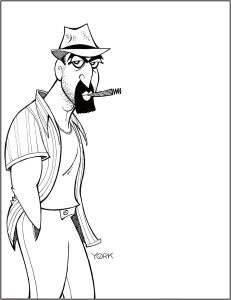
Original caricature by Jeff York of Javier Bardem in the new Apple Plus miniseries CAPE FEAR (copyright 2026).
Few actors can play both villain and hero as well as Javier Bardem. For every iconic baddie he plays, like in NO COUNTRY FOR OLD MEN and SKYFALL, he impresses on screen playing good men like in THE SEA INSIDE and BIUTIFUL. Now, he’s playing another iconic villain – the role of Max Cady in Apple TV’s new miniseries adaptation of CAPE FEAR. Robert Mitchum and Robert De Niro put their stamp on the released convict harassing the prosecutor who sent him to jail in their 1962 and 1991 film versions, but Bardem digs even deeper and delivers a scarier yet more sympathetic character than we’ve seen before. His Max is not a good guy by any means, but Bardem makes the ex-con more nuanced, sympathetic, and even quite charming.
It helps that Bardem has 10 episodes to explore the part in the newest version, but he runs with it, and when Bardem is on screen, it’s hard to take your eyes off him. That works especially well here, too, because Max Cady has the same effect on those around him. Try as they might to hate him, hurt him, or stop his shenanigans, he’s a roguish and wily S.O.B., and that gives this version of CAPE FEAR more depth, subtlety, and even pathos. More time doesn’t always help matters, as some parts of each episode feel a little padded, but taking more time to explore character and backstory makes the narrative much more interesting than the rather one-note versions in the previous two adaptations.
Indeed, there is much that is quite different here that should surprise even viewers quite familiar with the material, including the original 1957 source novel, The Executioners, by John D. MacDonald. For starters, Anna Bowden, the wife role, here played by Amy Adams, has been rewritten considerably as she is now Cady’s former defense attorney who helped taint the case when she became involved with the DA prosecuting Cady during the trial. Tom Bowden (Patrick Wilson) is a good man and was a formidable prosecutor assigned to go after Cady for murder, but he made many more bad decisions along the way than the lawyer did in previous versions, including fraternizing with opposing counsel. It’s not the only time he’ll screw up throughout the series. The same can be said of Anna. When Max returns to their tight-knit Savannah community, the couple will trip all over themselves, trafficking in self-delusions and lies that get compounded as they try to avoid telling those in their family or professional circle about all that really occurred 20 years ago when they were involved in Max’s murder trial.
There are differences at almost every step of the narrative from the previous versions, from Anna’s career, to the Bowdens having two teenage children (Lily Collins, Joe Anders), to Max moving into a house right across the street from them. We’re shown more of Max’s incarceration and how he was victimized by the prison system, and we get a better sense of the friends and colleagues in the Bowden orbit, as well as a more vivid feel for the Georgia setting. The cinematography does a nice, sweaty job of capturing the heat in the state, let alone the boiling resentment bubbling over in almost every character in the story.
Taking time to tell the tale lends it greater realism, and the histrionics build more evenly as well. Max doesn’t go over the top right away, like DeNiro did, howling with laughter in the cinema, and there’s more of a measured cat & mouse game afoot between Max and the Bowdens, let alone the two Bowdens. Again, they don’t have a good marriage like in the two films, but their deceit of each other becomes a fascinating new part of the drama here. There are some surprises too, in how violence occurs or doesn’t, the shifting loyalties of the two teens, and even in a celebrity cameo or two.
Throughout, the acting from the three principles is sharp, with Adams willing to make her Anna an obstinate and overly proud woman who might be her own worst enemy, and Wilson, taut and physical, making for a much better foil to Max than Nick Nolte’s lawyer did in ’92. (You’ll remember how he cowered behind a garbage dumpster when he sent hired thugs to beat up his nemesis, and they failed.) What is most surprising here is how unlikable the Bowdens are, including their children. Granted, they’re not sociopathic like Max turns out to be, but they are far from saints. Exceedingly far. It makes for a series where you may find your sympathies shifting from episode to episode.
The return of Bernard Herrmann’s iconic score still perfectly cues the melodramatic menace, and the writing and directing are always crisp and smart with just a touch of arch at the edges. Still, even with such strengths, it’s Bardem who steals the show handily, whether he’s casually showing up in public settings where he doesn’t belong, glaring with menace at his enemies, or gently stroking the Bowdens’ cat with genuine affection.
For audiences used to texts, TikToks, and Wikipedia pages, this CAPE FEAR may feel long enough to overstay its welcome a tad. But even with some fat that could have been trimmed, the miniseries expands and explores the pulpy narrative with both gusto and a surprising amount of grace. And Bardem alone is worth the investment.